Key takeaways
- One cubic yard of topsoil covers 81 sq ft at 4 inches deep, or 54 sq ft at 6 inches.
- A new lawn needs 4–6 inches and a garden bed about 6. Top-dressing a lawn you already have is a thin ¼–½ inch.
- Topsoil is sold by the cubic yard. A loose, dry yard weighs about 1.05 tons; a wet one about 1.6.
- Published bulk prices run $10–$55 a yard, with most homeowners paying $15–$30, plus a $50–$150 delivery fee.
How much topsoil do I need?
A 25 × 20 ft lawn area at 4 inches deep needs 6.48 cubic yards of topsoil with 5% extra for settling. Loose and dry, that’s about 6.8 tons, or 234 bags of 0.75 cu ft. You’d order 7 yards in bulk. The bag figure is there to show why nobody bags a lawn.
Here’s the same math for common jobs. These figures have no extra added, so add 5% to whatever you order.
| Project | Size and depth | Cubic yards | Tons | 0.75 cu ft bags |
|---|---|---|---|---|
| Top-dress a lawn | 40 × 25 ft, 0.5 in | 1.54 | 1.62 | 56 |
| Patch bare spots | 10 × 10 ft, 2 in | 0.62 | 0.65 | 23 |
| Vegetable or flower bed | 20 × 10 ft, 6 in | 3.70 | 3.89 | 134 |
| New lawn, side yard | 50 × 10 ft, 4 in | 6.17 | 6.48 | 223 |
| New lawn, 1,000 sq ft | 40 × 25 ft, 4 in | 12.35 | 12.96 | 445 |
| New lawn over hard subsoil | 40 × 25 ft, 6 in | 18.52 | 19.44 | 667 |
How to measure for topsoil
- Measure the area in feet. Lawns are rarely a clean rectangle. Break the shape into rectangles and triangles and add each one with Add another area.
- The depth is what you’re adding. Not the depth of soil you want in the end. If you’re filling a low spot, measure its deepest point and use about half of that as the average.
- Pick loose, packed or wet. The yards stay the same; only the weight changes. Most bulk topsoil arrives loose and a little damp.
- Leave the extra at 5%. Fresh topsoil settles after rain and rolling, and some always ends up in the lawn next to the pile.
How deep should topsoil be?
| Project | Depth | Notes |
|---|---|---|
| Top-dress an existing lawn | ¼–½ in | Screened soil, often blended with compost; grass should show through |
| Bare patches and low spots | Up to 2 in | Rake it level with the lawn around it, then seed |
| New lawn from seed or sod | 4–6 in | Use the full 6 in over hard subsoil or builder’s fill |
| Garden bed | 6 in | Mix in compost, or buy garden soil instead |
| Raised bed or deep fill | 12 in | Raised beds usually get a lighter bed mix |
The calculator’s depth buttons stop at 2 inches on the thin end. For a top-dressing, type 0.25 or 0.5 into the depth box yourself.
Which topsoil should you buy?
- Screened topsoil. Run through a mesh screen to take out rocks, roots and clods. It spreads smooth and rakes to a fine finish, which is what you want under seed or sod.
- Unscreened topsoil. Sold as dug, lumps and all. Cheaper, and fine for filling holes or building up a grade that gets a screened layer on top. For a deep hole that only needs filling, fill dirt costs less again.
- Loam. A soil with a balanced mix of sand, silt and clay. On a price sheet it usually means good-quality topsoil, screened or not.
- Black dirt. A regional name for dark topsoil. Ask the yard what’s in it, since it varies a lot from one supplier to the next.
- Topsoil and compost blend. Lighter (about 0.9 tons a yard) and richer. A good choice for top-dressing and for beds.
Why wet topsoil weighs more
Soil is mostly particles with air in between. When it rains, water fills those gaps. The volume barely changes, but the weight climbs fast. A yard of loose, dry topsoil weighs about 2,000–2,300 lb. Packed or damp, it’s 2,400–2,800 lb. Soaked, it can reach 3,000–3,400 lb, half again as heavy. The yards to tons converter lists the same figures next to gravel and sand.
That matters in two places. If you’re hauling it yourself, check the payload on your truck’s door-jamb sticker: one yard of dry topsoil can be more than a half-ton pickup should carry. And if a yard ever quotes topsoil by the ton, wet soil means you’re paying for water. Wet soil also clumps and smears when you rake it, so give a soaked pile a dry day before spreading.
Topsoil or garden soil?
Topsoil is the top layer of native ground, scraped up, screened and sold mostly as it is. It’s for lawns, grading and filling. Garden soil (also sold as planting mix) is topsoil blended with compost or other organic matter, made for growing flowers and vegetables. It costs more: Angi lists organic planting soil at $30–$50 a yard. For beds, raised beds and compost, use the soil calculator, which carries those mixes and their weights.
How much does topsoil cost?
Bulk topsoil is cheap per yard. Moving it is what adds up. Here’s what the major cost guides published this year.
| What you're buying | Published price | Source |
|---|---|---|
| Topsoil, bulk | $10–$55per cubic yard | [1] |
| Topsoil, bulk (typical)"most homeowners spending $15 to $30" | $15–$30per cubic yard | [1] |
| Screened topsoil | $20–$40per cubic yard | [2] |
| Unscreened topsoil | $10–$28per cubic yard | [2] |
| Topsoil, truckload (10–15 cu yd) | $150–$750per load | [1] |
| Topsoil, bagBag size not stated with the price | $2–$5per bag | [2] |
| Organic planting soil (garden soil) | $30–$50per cubic yard | [1] |
| Topsoil delivery (up to 15 cu yd)Some suppliers charge $65-$100 per hour instead | $50–$150per delivery | [1] |
- [1] Angi, What Is the Cost of Topsoil? [2026 Data], updated Oct 2026.
- [2] Lawn Love, How Much Does Topsoil Cost in 2026?, updated Oct 2026.
Prices as published by each source, checked November 2026. They are national ranges, not quotes: your local yard can be well above or below them.
For the 25 × 20 ft lawn area: 7 yards at the typical $15–$30 is $105–$210 of topsoil, or $155–$360 with a $50–$150 delivery fee. Screened topsoil at $20–$40 a yard puts the material at $140–$280. The same job in 234 bags at $2–$5 would be $468–$1,170, before you count the trips to the store.
Ordering a load
Ask the yard whether the topsoil is screened, the delivery fee, and the smallest and largest load the truck takes. Angi’s delivery figure covers loads up to 15 yards, and a new 1,000 sq ft lawn at 4 inches is about 13.
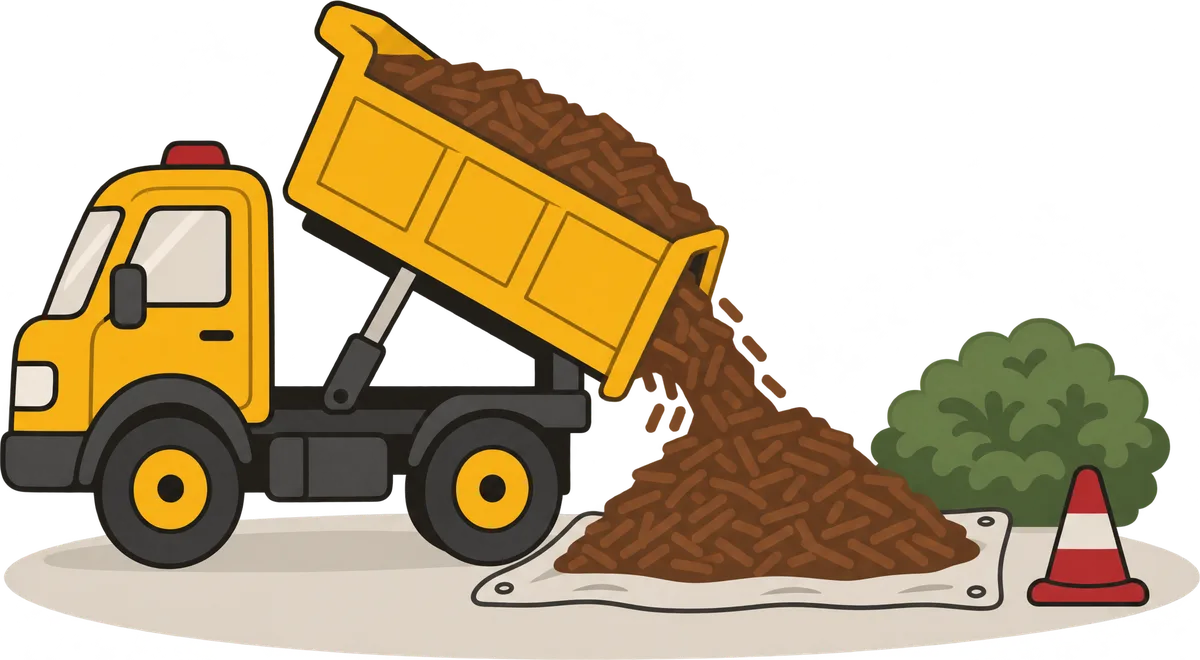
If you can, go and look at the pile first. Squeeze a handful: good topsoil crumbles apart. Then have the driver dump it on a tarp as close to the work as the ground allows. Six yards by wheelbarrow is a full day.
The topsoil formula
- Cubic feet = length (ft) × width (ft) × depth (in) ÷ 12
- Cubic yards = cubic feet ÷ 27
- Tons = cubic yards × 1.05 for loose, dry topsoil, 1.3 for packed or damp, 1.6 for wet, 0.9 for a topsoil and compost blend
Bags are cubic feet divided by the bag size, rounded up. The weights come from a regional materials weight chart and supplier calculators, listed on the methodology page. Once the bed is built, the mulch calculator works out what goes on top.
Topsoil coverage per cubic yard
A cubic yard is 27 cubic feet. Spread one inch thick, it covers 324 square feet. Divide 324 by your depth in inches and you have the coverage.
Every extra inch of depth shrinks the area. Exact figures in the table below.
- 1 in324 sq ft
- 2 in162 sq ft
- 3 in108 sq ft
- 4 in81 sq ft
- 6 in54 sq ft
| Depth | 1 cubic yard covers | Yards per 100 sq ft | Bags (0.75 cu ft) per 100 sq ft |
|---|---|---|---|
| 1 in | 324 sq ft | 0.31 yd³ | 12 bags |
| 2 in | 162 sq ft | 0.62 yd³ | 23 bags |
| 3 in | 108 sq ft | 0.93 yd³ | 34 bags |
| 4 in | 81 sq ft | 1.23 yd³ | 45 bags |
| 6 in | 54 sq ft | 1.85 yd³ | 67 bags |
| 8 in | 41 sq ft | 2.47 yd³ | 89 bags |
| 12 in | 27 sq ft | 3.70 yd³ | 134 bags |