Key takeaways
- One cubic yard of mulch covers 108 sq ft at 3 inches deep, or 162 sq ft at 2 inches.
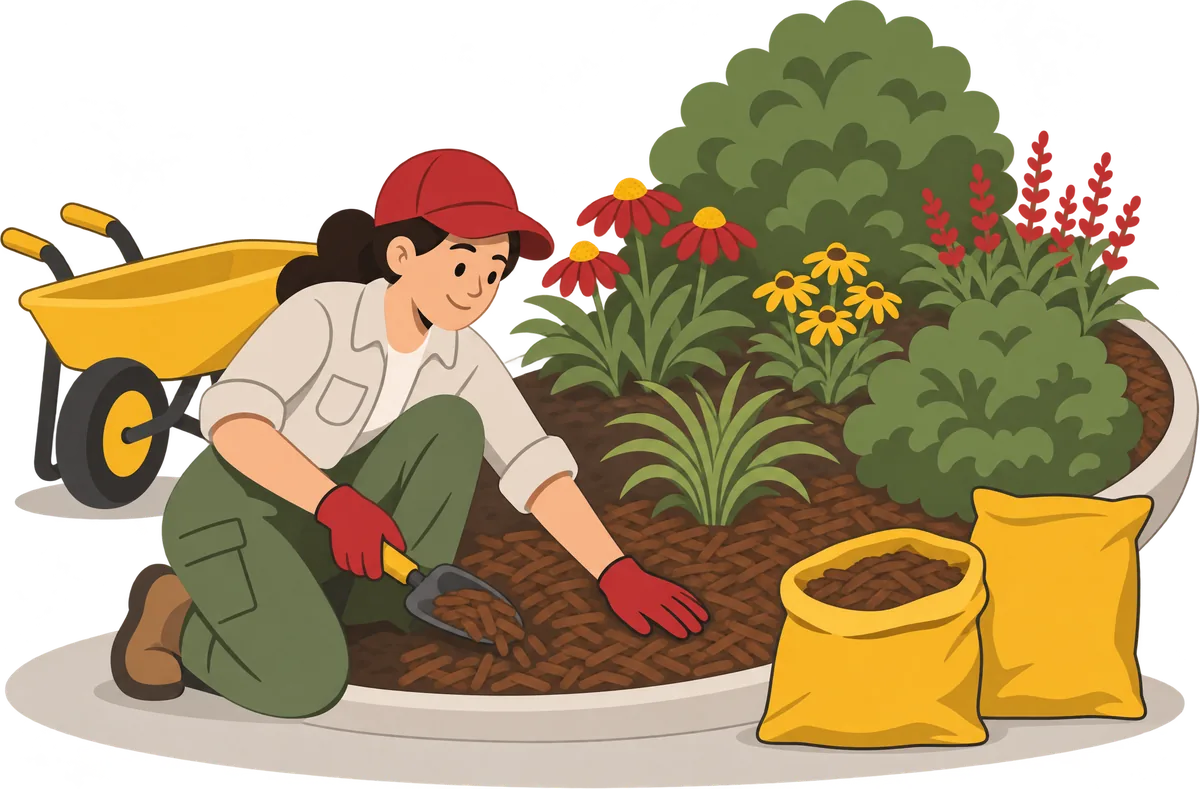
- Spread 2 inches in flower beds and 3 inches around trees and shrubs. Topping up last year’s mulch takes only 1 inch.
- Landscape yards sell mulch by the cubic yard. Stores sell 2 cu ft bags, and 13.5 of them make a yard.
- Published prices run $25–$100 a yard in bulk and $2–$8 a bag, plus a $50–$150 delivery fee.
How much mulch do I need?
A 20 × 10 ft bed at 3 inches deep needs 1.94 cubic yards of mulch with 5% extra for settling. That’s 27 bags of 2 cu ft. In bulk you’d order 2 yards. Mulch is sold by volume, so weight only matters for the truck: 2 yards of shredded hardwood is around 1,200 lb.
Here’s the same math for common jobs. These figures have no extra added, so add 5% to whatever you order.
| Project | Size and depth | Cubic yards | 2 cu ft bags |
|---|---|---|---|
| Perennial bed | 10 × 10 ft, 2 in | 0.62 | 9 |
| Ring around one tree (squared off) | 8 × 8 ft, 3 in | 0.59 | 8 |
| Shrub border | 20 × 5 ft, 3 in | 0.93 | 13 |
| Foundation bed along the house | 40 × 4 ft, 3 in | 1.48 | 20 |
| Island bed | 20 × 15 ft, 3 in | 2.78 | 38 |
| Refresh last year’s beds | 30 × 10 ft, 1 in | 0.93 | 13 |
How to measure a bed for mulch
- Measure each bed in feet. Take the longest and widest points. Split an L-shaped or kidney-shaped bed into rectangles and add each with Add another area. For a tree ring, pick Circle and enter the diameter.
- Don’t subtract the plants. Mulch goes around every shrub and perennial, and the small gaps aren’t worth the arithmetic. Only take out hard features like a patio or a shed slab.
- Check what’s already there. Push a trowel into the bed. If there are still 2 inches of last year’s mulch, you’re buying a 1-inch top-up, not a full 3 inches.
- Leave the extra at 5%. Fresh mulch is fluffy and settles after the first rain. The mulch type only changes the weight, since a yard of cedar covers the same ground as a yard of dyed hardwood.
How deep should mulch be?
| Where | Depth | Why |
|---|---|---|
| Flower and perennial beds | 2 in | Holds moisture without burying the crowns |
| Trees and shrubs | 3 in | Keeps weeds down; pull it back a few inches from trunks and stems |
| New bed with heavy weeds | 3–4 in | Blocks light; a layer of cardboard underneath helps |
| Top-up over last year’s mulch | 1 in | Brings the color back; the old layer is still working |
| Anywhere | Not over 4 in | Deeper than that, roots start to go short of air and water |
New bed or top-up?
This is where most people overbuy. A bare bed needs the full 3 inches. A bed you mulched last year usually still has half of it, broken down and faded but doing its job. One inch on top is enough to bring the color back.
For the 20 × 10 ft bed above, that’s the difference between 27 bags and 9. Run the calculator at 1 inch for a refresh, and rake the old layer loose first so the new mulch doesn’t sit on a mat.
Which mulch should you buy?
- Shredded hardwood. The default at most yards. The fibers knit together, so it stays put on slopes and in rain.
- Bark nuggets. Chunky and slow to break down. They float, so they wash out of beds that take roof or driveway runoff.
- Cedar or cypress. Lighter and slower to rot than hardwood, with the smell people buy it for.
- Dyed mulch (black, red or brown). Wood mulch with colorant added. It holds its color longer, where natural hardwood fades to gray in full sun within a season.
- Pine straw. Sold by the bale, not the yard. One bale covers roughly 40–50 sq ft.
- Rubber mulch. Doesn’t rot and weighs about twice as much as wood, so it’s often priced by weight. For stone as a mulch, use the rock and stone calculator.
Dyed mulch usually carries a premium, but not as much as you might guess. Angi puts the premium for dyed and specialty mulch at $10–$30 a yard. One Massachusetts supplier we checked charged less for black dyed mulch than for its natural dark brown.
| What you're buying | Published price | Source |
|---|---|---|
| Dyed or specialty mulch premiumAdd-on cost on top of standard mulch | $10–$30per cubic yard | [1] |
| Pine mulch, bulk (natural)Single supplier price, southeast Massachusetts | $41per cubic yard | [2] |
| Dark brown mulch, bulk (natural)Single supplier price, southeast Massachusetts | $43per cubic yard | [2] |
| Black wood mulch (dyed), bulkSingle supplier price, southeast Massachusetts | $42per cubic yard | [2] |
| Red hemlock mulch, enhanced (dyed), bulkSingle supplier price, southeast Massachusetts | $51per cubic yard | [2] |
- [1] Angi, How Much Does Mulch Delivery and Installation Cost? [2026 Data], updated Oct 2026.
- [2] Bridgewater Farm Supply (MA), Bark Mulch \ Wood Mulch.
Prices as published by each source, checked November 2026. They are national ranges, not quotes: your local yard can be well above or below them.
How much does mulch cost?
On a small order the delivery fee can cost as much as the mulch itself. Here’s what the major cost guides and one big-box store published this year.
| What you're buying | Published price | Source |
|---|---|---|
| Mulch, bulk (materials only) | $25–$100per cubic yard | [1] |
| Mulch, bulk (materials only) | $30–$135per cubic yard | [2] |
| Mulch, bag (1–3 cu ft)Source: "One bag usually contains 1 to 3 cubic feet" | $2–$8per bag | [1] |
| Shredded wood mulch, 2 cu ft bag at a big-box storeSingle retail price shown for Reston, VA store, Nov 2026 | $3.33per bag | [3] |
| Mulch delivery feeDepends on distance and order size | $50–$150per delivery | [1] |
| Mulch, delivered and installedIncludes delivery and labor | $50–$150per cubic yard | [1] |
- [1] HomeGuide, How Much Does Mulch Cost? (2026), updated Apr 2025.
- [2] Lawn Love, How Much Does Mulch Cost in 2026?, updated Oct 2026.
- [3] The Home Depot, Vigoro 2 cu. ft. Premium Brown Wood Shredded Bagged Mulch (52050196).
Prices as published by each source, checked November 2026. They are national ranges, not quotes: your local yard can be well above or below them.
For the 20 × 10 ft bed: 2 yards at $25–$100 is $50–$200 of mulch, and the $50–$150 delivery fee takes it to $100–$350. The same bed in 27 bags at $3.33 is about $90. Per yard, bags and bulk cost about the same (14 bags at $3.33 is $47), so on a small job the delivery fee is what decides it. HomeGuide’s delivered-and-installed rate, $50–$150 a yard, puts having it spread at $100–$300, which is worth a phone call before you plan the weekend.
Ordering a bulk load
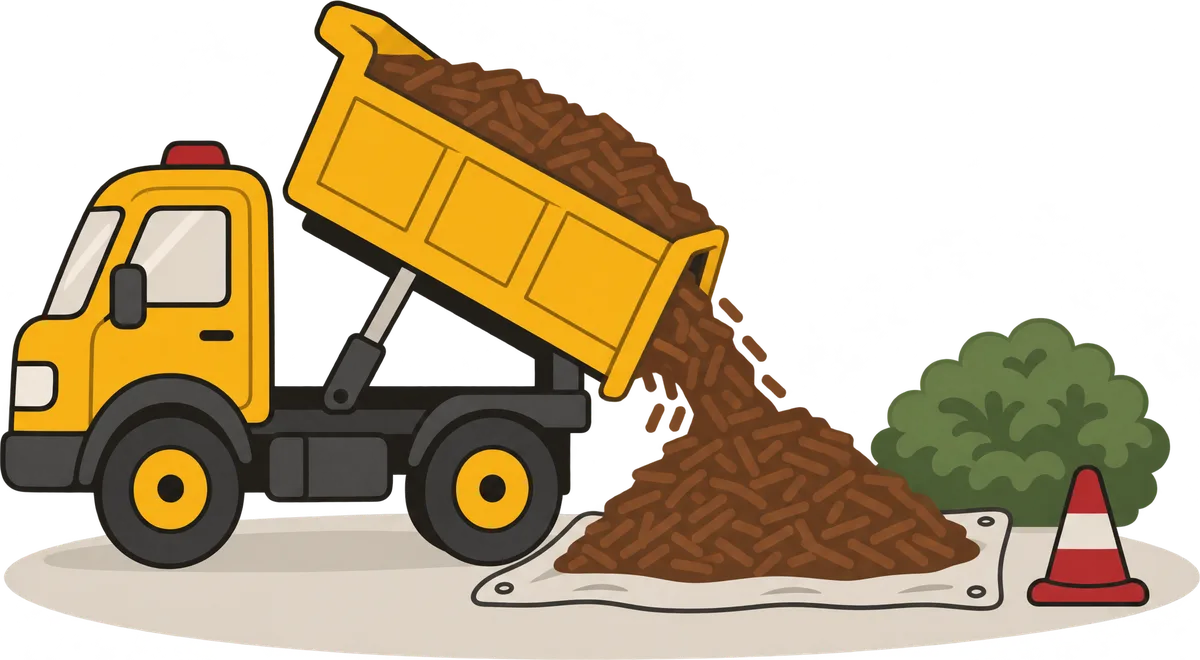
Mulch is a spring job, and that’s when landscape yards are busiest. Call a week or so ahead, and ask about the delivery fee, any minimum order, and whether they’ll load your pickup instead. Hauling it yourself skips the fee entirely.
Have the driver dump it on a tarp as close to the beds as the truck can get. Moving 2 yards by wheelbarrow is a morning. Moving it from the far end of the driveway is a day.
Bulk or bags?
A cubic yard is 27 cubic feet, so it takes 13.5 bags of 2 cu ft to make one. Round up to 14. Bags make sense for a bed or two, for spreading a little at a time, or when there’s nowhere to put a pile. They stack in a car and stay dry until you open them.
Past a couple of yards, bulk usually wins: one delivery fee spread over more mulch, and no 40 or 50 bags to haul and slit open. To see the break-even for your job, type the bag price into the calculator per bag, note the total, then switch to the yard’s price per cubic yard and add the delivery fee. The bags to yards converter handles 1.5 and 3 cu ft bags too.
The mulch formula
- Cubic feet = length (ft) × width (ft) × depth (in) ÷ 12
- Cubic yards = cubic feet ÷ 27
- Bags = cubic feet ÷ bag size (usually 2 cu ft), rounded up
Weight is optional for mulch because it’s sold by volume. The calculator shows it anyway (0.2–0.4 tons a yard for wood mulch) so you know whether a trailer can take the load. The figures and their sources are on the methodology page. If you’re adding compost or soil under the mulch, the soil calculator covers that layer, and the topsoil calculator handles a bed you’re building up from scratch.
Mulch coverage per cubic yard
Spread one inch thick, a cubic yard of mulch covers 324 square feet. Divide 324 by your depth in inches and you have the coverage.
Every extra inch of depth shrinks the area. Exact figures in the table below.
- 1 in324 sq ft
- 2 in162 sq ft
- 3 in108 sq ft
- 4 in81 sq ft
- 6 in54 sq ft
| Depth | 1 cubic yard covers | Yards per 100 sq ft | Bags (2 cu ft) per 100 sq ft |
|---|---|---|---|
| 1 in | 324 sq ft | 0.31 yd³ | 5 bags |
| 2 in | 162 sq ft | 0.62 yd³ | 9 bags |
| 3 in | 108 sq ft | 0.93 yd³ | 13 bags |
| 4 in | 81 sq ft | 1.23 yd³ | 17 bags |
| 6 in | 54 sq ft | 1.85 yd³ | 25 bags |