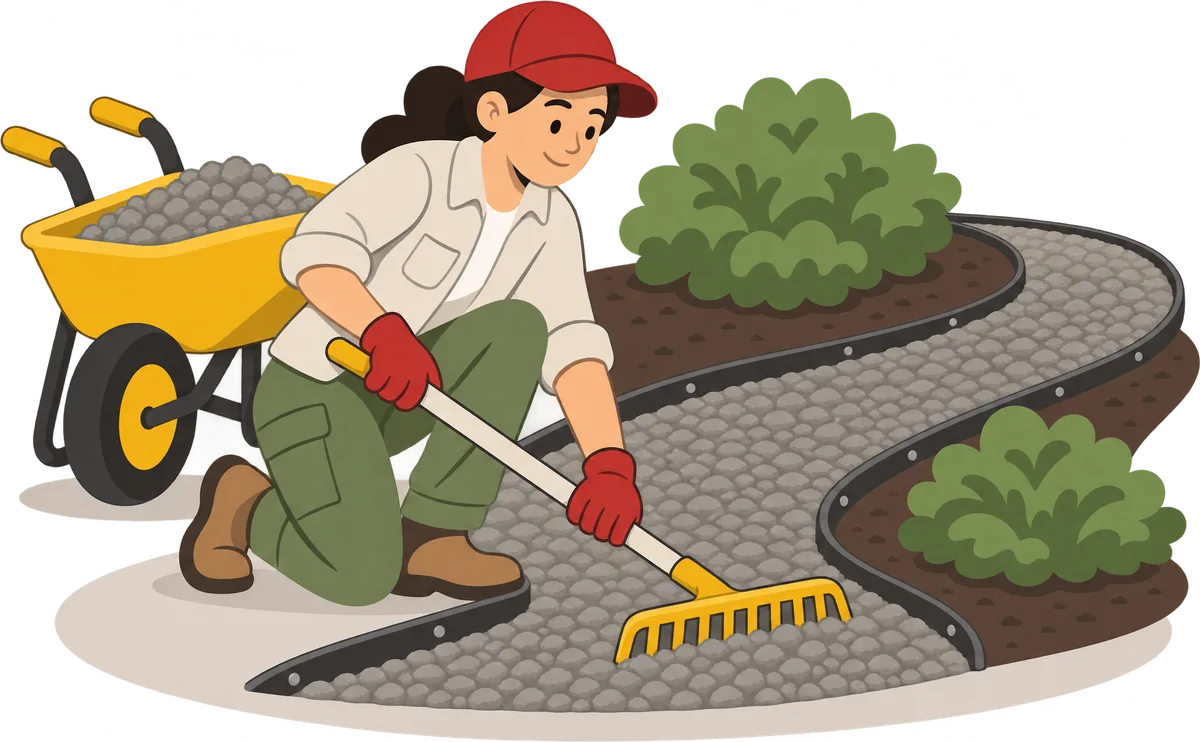
Key takeaways
- One cubic yard of gravel covers 108 sq ft at 3 inches deep and weighs about 1.4 tons.
- Paths and beds need 2–3 inches. A driveway needs a 4–6 inch compacted base with 2–3 inches of stone on top.
- Most yards sell gravel by the ton, so the tons figure is the one to read out on the phone.
- Published prices run $10–$50 a ton in bulk, before delivery. Bags make sense only for small jobs.
How much gravel do I need?
A 12 × 10 ft path at 3 inches deep needs 1.22 cubic yards of gravel with 10% extra for settling. That's about 1.7 tons, or 66 bags of 0.5 cu ft. Most yards load in half-ton or half-yard steps, so you'd order 2 tons and keep the leftover in a corner for topping up next spring.
Here's the same math for jobs people ask about most. These figures have no waste added, so add 10% to whatever you order.
| Project | Size and depth | Cubic yards | Tons | 0.5 cu ft bags |
|---|---|---|---|---|
| Garden bed | 10 × 10 ft, 2 in | 0.62 | 0.86 | 34 |
| Side-yard path | 30 × 3 ft, 3 in | 0.83 | 1.17 | 45 |
| Patio or shed pad | 12 × 12 ft, 4 in | 1.78 | 2.49 | 96 |
| Single-car driveway, top layer | 40 × 10 ft, 3 in | 3.70 | 5.19 | 200 |
| Single-car driveway, base layer | 40 × 10 ft, 6 in | 7.41 | 10.37 | 400 |
| Two-car driveway, top layer | 40 × 20 ft, 3 in | 7.41 | 10.37 | 400 |
How to measure for gravel
- Measure length and width in feet. Use the longest and widest points. For a curved bed, split it into two or three rough rectangles and add each with Add another area. Round beds take the diameter; triangles take the base and height.
- Pick a depth. This is the number people guess, and guessing low is the usual reason a job runs short. Use the depth table below.
- Choose the gravel type. It changes the weight. Crusher run packs tight and runs heavier than loose pea gravel, so the same yard weighs a different amount.
- Leave the waste at 10%. Gravel settles into the soil, spills at the edges and compacts under feet and tires. For a crusher run base, slide it up to 15% or 20%, since that material compacts a lot.
How deep should gravel be?
| Project | Depth | What to order |
|---|---|---|
| Garden bed or ground cover | 2–3 in | Pea gravel, river rock, decomposed granite |
| Walkway or path | 3 in over a 2 in base | ¾-inch crushed stone, or pea gravel over fabric |
| Patio base under pavers | 4–6 in, compacted | Crusher run or road base |
| Driveway base | 4–6 in, compacted | Crusher run, #2 or #3 stone |
| Driveway top layer | 2–3 in | ¾-inch crushed stone, #57 limestone |
| French drain | Fill the trench around the pipe | Washed ¾–1½ inch stone |
| Shed or hot-tub pad | 4 in, compacted | Crusher run, then ¾-inch stone |
Which gravel should you buy?
The name on the price sheet matters more than the color. Here's what each common type is actually good for.
- ¾-inch crushed stone (often sold as #57). The all-rounder. Angular, drains well, stays put on paths and driveway tops.
- Crusher run (also called crush and run, road base or dense grade). Crushed stone mixed with stone dust. It packs almost as hard as concrete, which makes it the base layer, not the finish.
- Pea gravel. Small, smooth and comfortable underfoot. Good for play areas, fire pits and between stepping stones. It rolls, so it needs edging.
- Decomposed granite. Fine and sandy. Packs into a firm, natural-looking path in dry climates.
- River rock. Rounded and decorative, mostly for beds and drainage. The rock and stone calculator has more decorative options.
How much does gravel cost?
Bulk gravel is cheap per ton. Getting it to your house is what adds up. Here's what the major cost guides published this year, so you can tell whether a quote is in the normal range.
| What you're buying | Published price | Source |
|---|---|---|
| Gravel or crushed stone, bulk | $10–$50per ton | [1] |
| Gravel or crushed stone, bulk | $15–$75per cubic yard | [1] |
| Pea gravel$28/ton when ordering at least 24 tons | $28–$45per ton | [1] |
| Crusher run (crush and run) | $24–$34per ton | [1] |
| Crushed limestone | $30–$38per ton | [1] |
| Plain pea gravel or crushed stone, bagSource: bag "covers 2 cubic feet or less" | $2–$6per bag | [1] |
| Pea gravel, 0.5 cu ft bag at a big-box storeSingle retail price shown for Reston, VA store, Nov 2026 | $6.24per bag | [2] |
| Bulk deliveryOr free with a 5-ton minimum up to 5 miles; add $10 per extra mile | $10–$25per ton | [1] |
- [1] HomeGuide, How Much Does Crushed Stone or Gravel Cost? (2026), updated Dec 2025.
- [2] The Home Depot, Vigoro 0.5 cu. ft. Bagged Pea Gravel Pebble Landscape Rock (54255).
Prices as published by each source, checked November 2026. They are national ranges, not quotes: your local yard can be well above or below them.
Put those together for the 12 × 10 ft path above. About 1.7 tons at $10–$50 a ton is roughly $17–$85 of stone. The same job in 66 bags at $2–$6 each is $132–$396, plus a lot of trips to the car. So bulk wins easily once delivery is reasonable. HomeGuide notes that some yards deliver free within about five miles on orders of five tons or more.
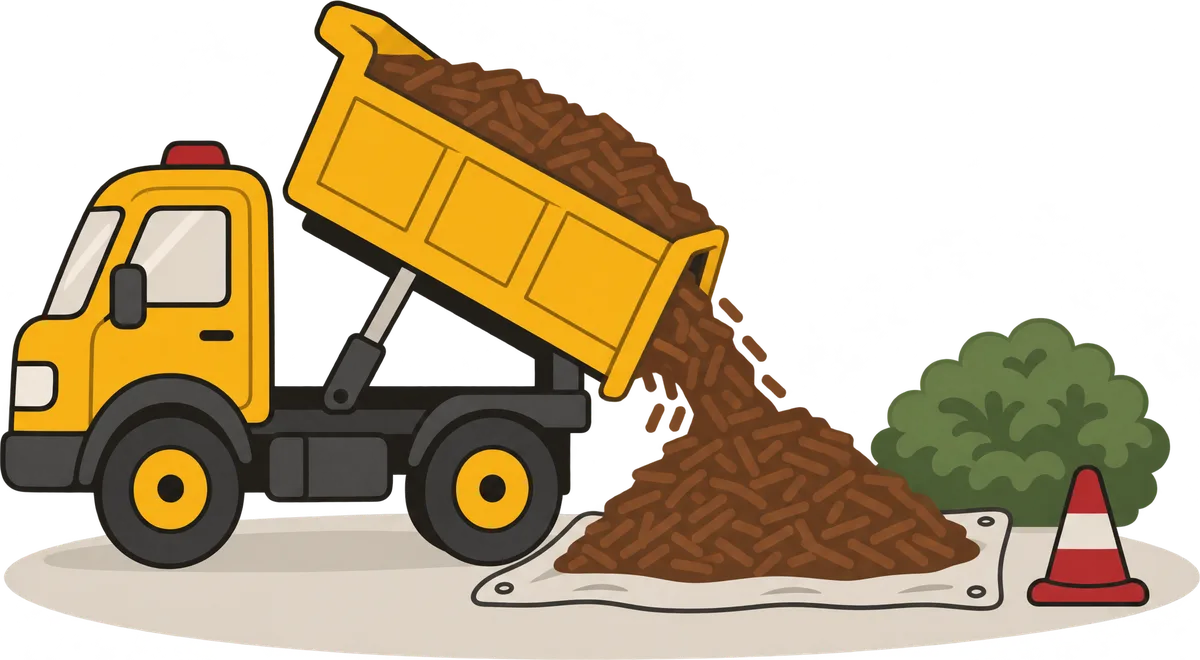
Before the truck shows up
Ask the yard three things when you order: the delivery fee, whether there's a minimum load, and how wide the truck is. A full-size dump truck needs a clear path about 10 feet wide and firm ground. It can crack a thin concrete driveway.
Lay a tarp where you want the pile and point it out to the driver. Gravel dumped on grass is gravel you'll be raking out of the lawn for years.
Bulk or bags?
Bags make sense for small jobs: under about a third of a yard, which is around 18 bags of 0.5 cu ft. That covers a single small bed or a few stepping-stone gaps. Past that, bulk is cheaper per ton even after delivery, and you don't have to lift fifty-pound bags in and out of a trunk.
To find the break-even for your job, type the bag price into the calculator with per bag, note the total, then switch to the per-ton price and add the delivery fee.
The gravel formula
The calculator does three steps you can also do on the back of a receipt:
- Cubic feet = length (ft) × width (ft) × depth (in) ÷ 12
- Cubic yards = cubic feet ÷ 27
- Tons = cubic yards × 1.4 for crushed stone, 1.35 for pea gravel or river rock, 1.45 for crusher run or #57 limestone
Bags are cubic feet divided by the bag size, rounded up. The weights come from quarry and landscape-supply charts, which are listed on the methodology page. If your quote is in tons and you want yards, the yards to tons converter works it backwards.
Gravel coverage per cubic yard
A cubic yard is 27 cubic feet. Spread one inch thick, it covers 324 square feet. Divide 324 by your depth in inches and you have the coverage.
Every extra inch of depth shrinks the area. Exact figures in the table below.
- 1 in324 sq ft
- 2 in162 sq ft
- 3 in108 sq ft
- 4 in81 sq ft
- 6 in54 sq ft
| Depth | 1 cubic yard covers | Yards per 100 sq ft | Bags (0.5 cu ft) per 100 sq ft |
|---|---|---|---|
| 1 in | 324 sq ft | 0.31 yd³ | 17 bags |
| 2 in | 162 sq ft | 0.62 yd³ | 34 bags |
| 3 in | 108 sq ft | 0.93 yd³ | 50 bags |
| 4 in | 81 sq ft | 1.23 yd³ | 67 bags |
| 6 in | 54 sq ft | 1.85 yd³ | 100 bags |
| 8 in | 41 sq ft | 2.47 yd³ | 134 bags |
| 12 in | 27 sq ft | 3.70 yd³ | 200 bags |