Key takeaways
- One cubic yard of river rock covers 108 sq ft at 3 inches and weighs about 1.35 tons. Lava rock weighs only about 0.75.
- Most decorative stone goes 2–3 inches deep over landscape fabric. Cobbles of 3–5 inches need 4 inches or more.
- Stone yards sell by the ton. A ton of river rock covers about 80 sq ft at 3 inches. A ton of lava rock covers about 144.
- Published prices run $45–$130 a ton for river rock, $80–$240 for lava rock and $475–$800 for Mexican beach pebbles.
How much rock do I need?
A 20 × 6 ft bed at 3 inches deep needs 1.22 cubic yards of river rock with 10% extra. That's about 1.65 tons, or 66 bags of 0.5 cu ft. The same bed in lava rock is only about 0.92 tons. Most yards load in half-ton steps, so you'd order 1.75 tons of river rock or 1 ton of lava rock.
Here's the same math for common rock jobs. These figures have no waste added, so add 10% to whatever you order.
| Project | Size and depth | Cubic yards | Tons | 0.5 cu ft bags |
|---|---|---|---|---|
| Strip along the foundation | 20 × 3 ft, 3 in | 0.56 | 0.75 | 30 |
| Front bed | 15 × 6 ft, 3 in | 0.83 | 1.13 | 45 |
| Decomposed granite path | 25 × 4 ft, 3 in | 0.93 | 1.25 | 50 |
| Dry creek bed | 30 × 3 ft, 4 in | 1.11 | 1.50 | 60 |
| Side yard | 40 × 5 ft, 3 in | 1.85 | 2.50 | 100 |
| Large bed in cobbles | 20 × 10 ft, 4 in | 2.47 | 3.33 | 134 |
How to measure for rock
- Measure length and width in feet. A border along a house is a long rectangle. Measure each side as its own area with Add another area so you don't count the corners twice. Round beds around a tree take the diameter.
- Pick a depth to match the stone. Bigger stones need a deeper layer to cover the fabric. Use the table below.
- Choose the stone type. River rock, marble chips and granite weigh about the same. Lava rock weighs a little over half as much, so a ton goes much further.
- Leave the waste at 10%. Stone settles after the first rain and works into the soil at the edges.
How deep should rock be?
| Stone | Good for | Depth |
|---|---|---|
| Decomposed granite | Paths and patios in dry climates | 2–3 in, compacted on paths |
| Marble chips | Beds and borders | 2–3 in |
| Lava rock | Beds and borders | 2–3 in |
| River rock, 1–3 in | Beds, downspout and drainage strips | 3 in |
| Cobbles, 3–5 in | Edges, creek beds | 4–5 in |
| Crushed limestone | Paths, under stepping stones | 3 in |
| Dry creek bed | Mixed river rock with boulders | About 4 in, boulders counted separately |
Which rock should you buy?
Color sells the stone, but size and shape decide how it behaves in the bed.
- River rock. Smooth and rounded, 1–3 inches for most beds. It rolls underfoot, so keep it out of walkways. Good for drainage strips and dry creek beds.
- Lava rock. Porous, light and red or black. Easy to spread, and a ton covers almost twice the area of river rock. It's rough on bare hands.
- Marble chips. Bright white. Marble is a form of limestone, so it can raise the soil pH around acid-loving plants like azaleas.
- Crushed limestone. Angular gray stone that packs down. Better for paths than beds. The gravel calculator covers it as #57 stone for driveways.
- Decomposed granite. Fine and sandy, and packs into a firm path. Tan or gold in color.
- Mexican beach pebbles. Smooth, dark and polished-looking, and the most expensive stone on the list by a wide margin. Use them for accents.
Rock beds and dry creek beds
For a rock bed, strip the grass, rake the soil smooth and lay landscape fabric before any stone goes down. Overlap the seams by about 6 inches and pin them. Put in edging so the stone doesn't migrate into the lawn. Cut an X in the fabric for each plant.
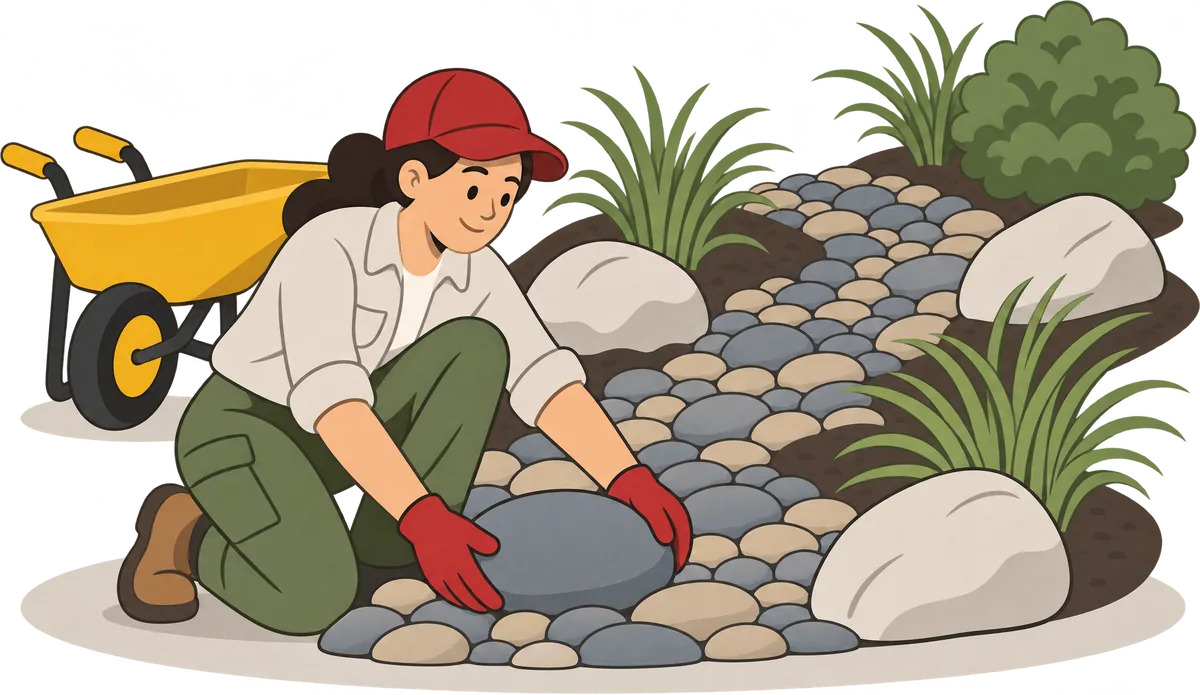
A dry creek bed is a shallow, winding trench lined with fabric. Set larger stones along the edges and at the bends, then fill the channel with river rock about 4 inches deep. Measure the channel as a few rectangles in the calculator. Boulders are bought by the piece or by the ton, so count them separately.
How much does landscape rock cost?
Decorative stone costs more per ton than plain gravel, and the range between types is wide. HomeGuide publishes two guides with different figures for some stones. The table uses its river-rock guide where it covers the stone, and its gravel guide for limestone and marble.
| What you're buying | Published price | Source |
|---|---|---|
| River rockBased on 1-4 in. river rock | $45–$130per ton | [1] |
| Lava rock | $80–$240per ton | [1] |
| Crushed or decomposed granite | $45–$95per ton | [1] |
| Crushed limestone | $30–$38per ton | [2] |
| Marble chipsPage text; the rock-type table lists crushed marble at $27-$64/ton | $90–$95per ton | [2] |
| Mexican beach pebbles | $475–$800per ton | [1] |
| Boulders and large landscape rocks | $100–$350per ton | [1] |
| Landscape rock deliveryTotal; minimum orders 1-3 cu yd or 1-4 tons | $30–$100per delivery | [1] |
- [1] HomeGuide, How Much Do Landscaping River Rocks and Stones Cost? (2026), updated Dec 2025.
- [2] HomeGuide, How Much Does Crushed Stone or Gravel Cost? (2026), updated Dec 2025.
Prices as published by each source, checked November 2026. They are national ranges, not quotes: your local yard can be well above or below them.
For the 20 × 6 ft bed, 1.65 tons of river rock at $45–$130 a ton is $74–$215 of stone. Crushed limestone, which is heavier at 1.77 tons, comes to $53–$67. Marble chips run $149–$157. Mexican beach pebbles for the whole bed would be $784–$1,320. Add $30–$100 for delivery. Note the minimum order on that row: at 1.65 tons, this bed is close to it.
Before the truck shows up
Ask the yard for the delivery fee, the minimum load and the weight per yard of the stone you're buying. The weight lets you check whether a quote in tons covers your bed. The yards to tons converter does the check.
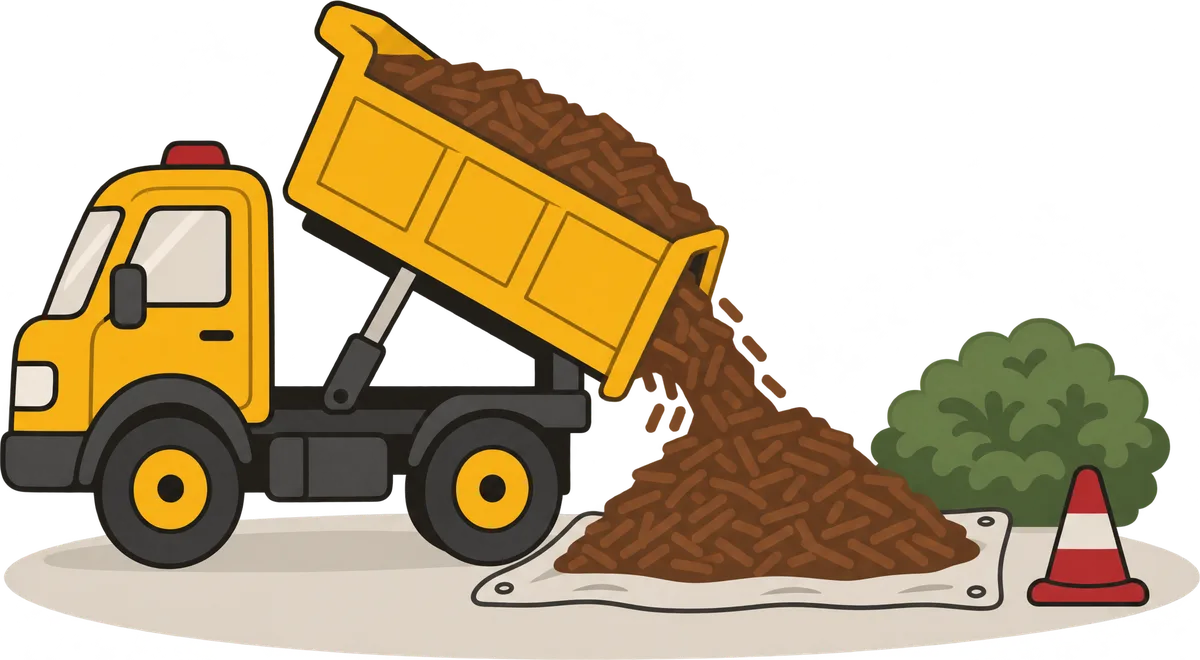
Have the stone dumped on a tarp or on the driveway, not the lawn. A dump truck is heavy enough to crack a thin concrete driveway, so ask the driver where they want to stand the truck.
Bulk or bags?
A 0.5 cu ft bag holds about 50 lb of river rock, and a yard is 54 bags. Bags are fine for an accent around a birdbath or a 5 × 4 ft strip by a downspout, which is about 7 bags. For a bed like the 20 × 6 ft example, 66 bags is a lot of lifting. Bulk is cheaper well before that, even with delivery. To check, type the bag price into the calculator with per bag, then switch to the per-ton price and add the delivery fee.
The rock formula
- Cubic feet = length (ft) × width (ft) × depth (in) ÷ 12
- Cubic yards = cubic feet ÷ 27
- Tons = cubic yards × 1.35 for river rock, marble or granite, 1.45 for crushed limestone, 0.75 for lava rock
Bags are cubic feet divided by the bag size, rounded up. The weights come from quarry and landscape-supply charts listed on the methodology page. For plain volume of any material, use the cubic yard calculator. For bedding sand under flagstone, use the sand calculator.
Rock coverage per cubic yard
A cubic yard is 27 cubic feet. Spread 1 inch thick, it covers 324 square feet, whatever the stone. Divide 324 by your depth in inches to get the coverage. The tons depend on the stone type.
Every extra inch of depth shrinks the area. Exact figures in the table below.
- 2 in162 sq ft
- 3 in108 sq ft
- 4 in81 sq ft
- 5 in65 sq ft
- 6 in54 sq ft
| Depth | 1 cubic yard covers | Yards per 100 sq ft | Bags (0.5 cu ft) per 100 sq ft |
|---|---|---|---|
| 2 in | 162 sq ft | 0.62 yd³ | 34 bags |
| 3 in | 108 sq ft | 0.93 yd³ | 50 bags |
| 4 in | 81 sq ft | 1.23 yd³ | 67 bags |
| 5 in | 65 sq ft | 1.54 yd³ | 84 bags |
| 6 in | 54 sq ft | 1.85 yd³ | 100 bags |